Sunday, February 20, 2011

Pulau Payar


Although the best scuba diving in Malaysia is off of the east coast of the peninsula and in Borneo, there is diving near Langkawi. Pulau Payar, a small island located about an hour boat ride from Langkawi is rated as the 7th best place to dive in Malaysia (I have already been to #1 and #5 and hope to visit #s 2 and 3 in the next couple of months).

I started out my day trip to Pulau Payar with another cramped mini-bus ride across the island to East Marine Diver's shop.

Here is the view of the ferry terminal from the dive shop.


The dive shop was located at the Royal Langkawi Yacht Club.


East Marine Divers runs daily snorkelling-scuba trips to Pulau Payar. The day I went there were many more snorkellers than divers. We made the crossing in a nice big boat. When we arrived at Pulau Payar they moored the boat in a beautiful cove. The snorkellers were all transported to the snorkelling beach while the divers took their first dive of the day.


Getting ready to dive. I am second from the left.


Brief dive report- I must admit that that I started the day with minimal expectations of the diving, so I would have been happy just getting wet. However, I was quite surprised by how much I enjoyed my two dives. Although the visibility was not great, it was certainly good enough to be able to see lots of interesting marine life. I dove in a group with only one other driver and our dive guide Othman worked hard to show us lots of interesting critters. Because Pulau Payar is a protected marine park there is no fishing in the area. Thus, we saw lots of fishes and many of them (e.g., groupers) were quite large. The most interesting things that I saw were several pipefish, two sea horses, and some very strange crabs (I have never seen crabs like this before- I am still trying to identify them) living underneath sea anemones. I had a great day of diving!

After our morning dive we joined everyone else at the snorkelling beach.


We had lunch in very nice shelters on the beach.


I think that the snorkellers enjoyed their visit to Pulau Payar. Because snorkellers commonly feed the fishes, the snorkellers were able to get quite close to the action (including nurse sharks). It was common to hear a kid shrieking when a nurse sharke ventured a little too close. This photo, taken from the dock, shows a small nurse shark.


Heading back to Langkawi.


My BCD enjoying the view.


More of the beautiful Langkawi islands.

Friday, February 18, 2011

Langkawi Boat Tour- More Interesting Stuff

Life on the Mudflats

The mangroves live in the intertidal region which means that sometimes the area is covered by water and other times it is covered by water. The mudflats are important habitat for animals when they are exposed to the air.


This shot of the mudflat shows two interesting mudflat inhabitants- crabs and mudskippers. Mudspkippers are fishes that are adapated to living at the land-sea interface. They use their pectoral fins to walk around in the mud. I can mangify this photo on my computer so that it is easy to see the critters, but I don't know how to save and post the magnified photo. If you double click the photo then you can see a larger version and get a better view of these really interesting fish. This is the first time I have ever seen a live mudskipper.


Our guide thought that these footprints were probably made by an otter. I would have liked to see that.


Fish Farm

One stop on the boat tour was at a "fish farm". It didn't look like an place where they were actively raising fish for profit, but rather a place where they had some marine live for tourists to look at. These small enclosures held fishes such as jacks, groupers, and stingrays among others.


These are Archer Fish. I have seen Archer Fish several times during other trips through the mangroves in the Indo-Pacific region. However, I had never seen their famous behavior until the visit to the fish farm.


Archer fish are able to hunt for insects that live on the mangrove roots by spitting a stream of water that knocks the insects off of their perch into the water. Here you can see the stream of water heading towards a piece of squid (the white blotch)stuck to the pole. It was a direct hit every time! They said that they were able to hit targets up to three meters away. I think that seeing the Archer Fish hit its target was my favorite part of the whole trip!


The guide is showing us a horeshoe crab. This was the first time that I had seen a live one.


Charcoal Kiln

The brick structure on shore is a kiln that was formerly used to make charcoal. The mangroves are now protected so they can no longer make charcoal out of the mangrove wood.


The Crocodile Cave

The boat passed through a small cave known as Crocodile Cave. This cave got its name because some of the local people thought that some of the rocks looked like a crocodile. No fear of giant reptiles in this cave.


Looking through the cave to the other side.


Some of the formations inside of the cave.


Another tour boat following us through the cave.


Rivers passing through the mangroves can be important means of navigation for many inland and island areas. Here they joined two river systems together by blasting a passage through a small rock mountain. Now they can travel from one part of the island to another without having to enter the open sea.

Langkawi Boat Tour- Bat Cave

A popular stop on the boat tour was a visit to the Bat Cave. After getting off of the boat we walked along a well-developed wooden walkway that led into a cave. The roosting bats, the geological formations within the cave, and some of the plants living near the cave made this a very interesting stop.


There were about 3000 horshoe bats (genus Rhinolophus- I hope I got that right or else I will hear about it from the bat researchers at Tech). Unlike the fruit bats that we saw roosting in trees, these cave roosting bats eat insects.It was fun to see how creeped out some people were by being so close to bats. I guess that there are worried about the bats gettin caught in their hair!


It was always possible to view the outside world from inside of the cave. There were some interesting stalagtites, stalagmites, and columns in the cave.


This stalagtite was hanging under a ledge on the outside of the cave. It you look carefully you can see that unlike most stalagtites that fall straight down from the ceiling, that this stalagtite is curved. It turns out that this growth form arises because algae growing on the stalagtite causes it to grow towards the light.


The plant that looks sory of like a palm is actually a cycad. Cycads are primitive seed-producing, non'flowering plants (Gymnosperms) that today are considered to be "living fossils". At least now I will have a photo of a cycad to show when I teach about plant diversity in the future.


The boats are lined up waiting to pick up passengers from the bat cave. I thought that they did a good job of concentrating the tourist activity in Langkawi so that tourists got to see and experience interesting things while still leaving the environment as untouched as possible.

Langkawi Eagles


photo from http://leongyiyang.blogspot.com.

The name Langkawi comes from the Maly words for "red eagle". Langkawi is well known for the many birds of prey that soar above the island.

The Brahminy Kite (Haliastur indus), sometimes known as the Red-backed Sea-eagle, is the most common bird of prey in Langkawi. In fact, the iconic tourist symbol for Langkawi is a large statue of this species that sits in Eagle Square located near the ferry teminal in Kuah, the main town on Pulau Langkawi. I saw the statue from a distance, but because I was always carrying too much luggage and I was on a tight schedule, I was unable to take a photo of the statue myself. Luckily, it seems that every other tourist who has ever visited the island has posted a photo on the internet (see photo above).

The Brahminy Kite is primarily a scavenger, feeding mainly on dead fish and crabs, but they will sometimes hunt for live prey such as hares and bats. They will sometimes try to steal food from other species of birds (a behavior known as "kleptoparasitism").

http://en.wikipedia.org/wiki/Brahminy_Kite

During our boat tour through the mangroves we passed through a part of the river that was popular with the birds of prey. I think that some of the boats might have thrown food in the water to attract the birds, but our boat didn't. Here are a few shots of the eagles I saw.


Thursday, February 17, 2011

Boat Tour Through The Mangroves

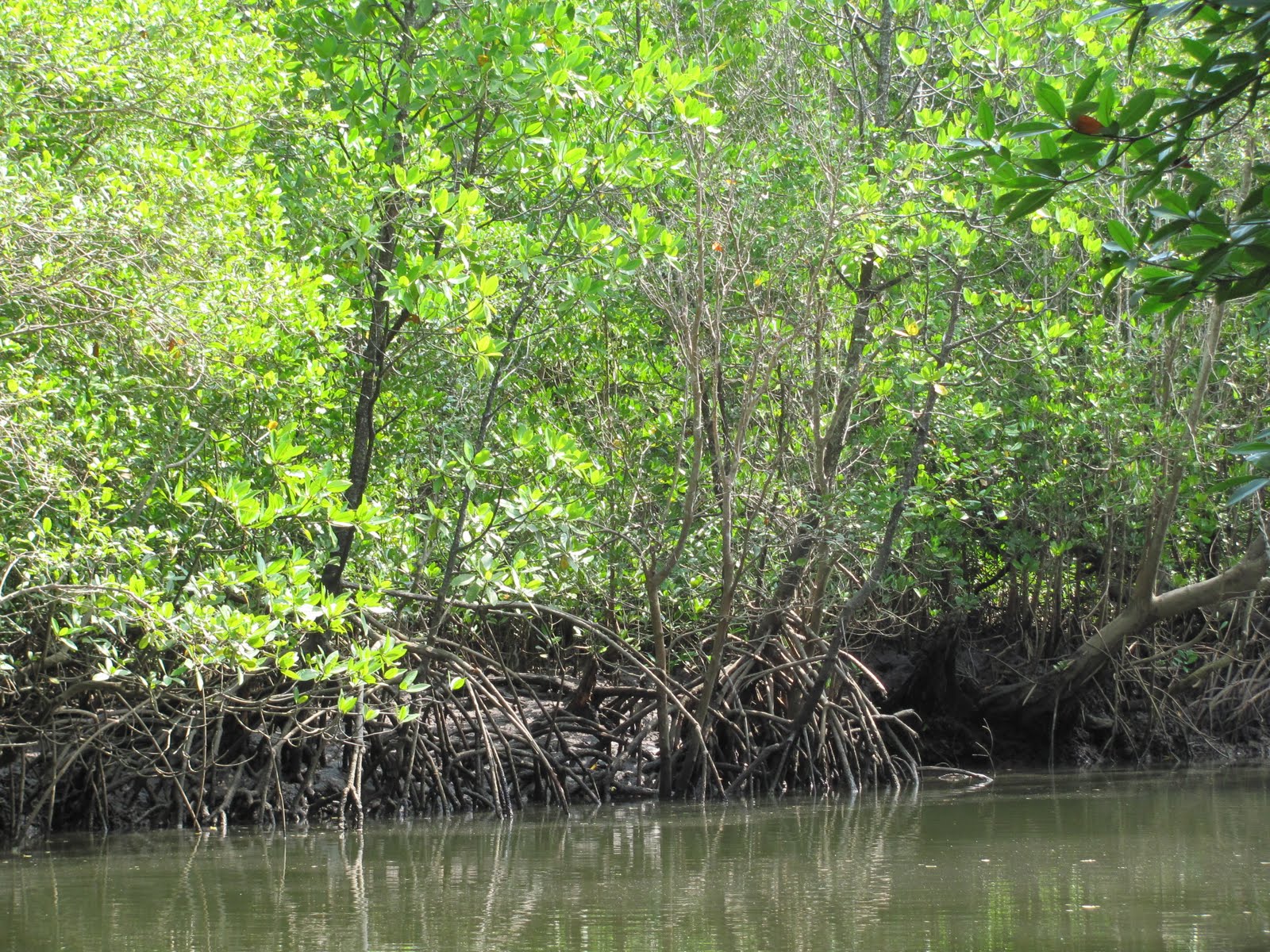
The boat tour entered the mangroves from the sea through the mouth of a large river. As we moved upstream the river became progressively smaller.

Mangroves from the center of a wide river.


Strange looking prop roots on this species.


Moving through a slighly narrower river.


Getting still narrower.


You can see that the water appears brown and dirty. However, the water is not dirty, it is just stained. The leaves of many mangrove plants contain tannins that are added to make the leaves taste bad to herbivores. When the leaves fall into the water the tannins seep out of the leaves into the water making it darker. Sort of like tea.


Prop roots can get quite thick and tangled.

Wednesday, February 16, 2011

Swimming Monkeys

One of the new things that I saw during the boat trip through the mangroves was swimming monkeys! Who knew that monkeys could swim?!? It turns out that a number of different kinds of monkeys are able to swim either to find food or to get from one place to the other.

These long-tailed macaques, or crab-eating macaques, have learned how to swim in order to hunt for crabs in the mangroves.

Boat tours through the mangroves are a popular activity at Langkawi. Thus, these monkeys get a lot of visitors. These guys are waiting for the next boat to arrive.


The guide enticed the monkeys into the water by tossing in slices of bread.


The monkeys swam using a monkey-style dog paddle.


The smaller, younger monkeys did not get into the water. I am not sure if it is because they are unable to swim yet or because they are afraid to fight with the larger monkeys. This little guy picked up his slice of bread by hanging upside down from a branch and grabbing the bread as if floated by.


The moms with babies just sat on a nearby rock watching the action.